Teacher Desvin
Solutions & breakdown by Teacher Desvin

2025 CCHS Sec 3 EOY Additional Math — Full Worked Solutions

Chung Cheng High School (Yishun) · Secondary 3 G3 · 29 September 2025

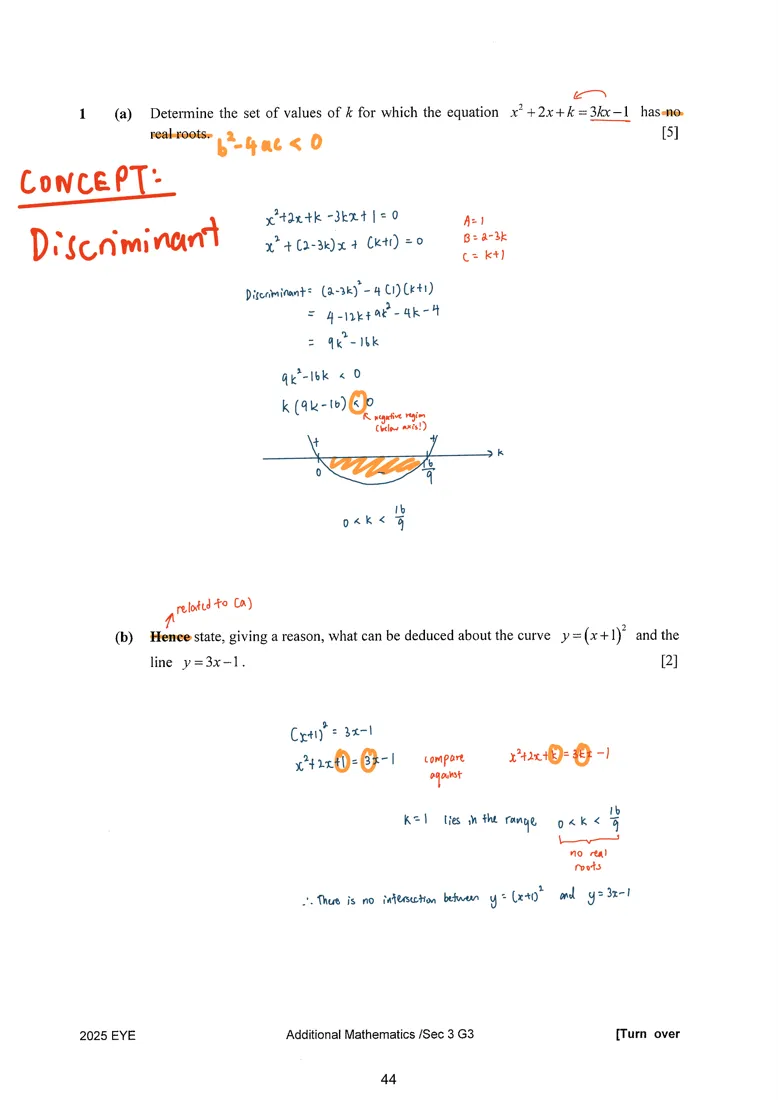
Preview of the annotated PDF answer scheme, with Teacher Desvin's handwritten concept notes and worked steps Click to expand

Want the full blank question paper and answer key with annotations to help you ace your exams?

Annotations by Teacher Desvin

1 Quadratics — discriminant 7 marks
a Determine the set of values of k for which the equation x² + 2x + k = 3kx − 1 has no real roots. [5]
Show working
Concept: Discriminant
Rearranging into ax² + bx + c = 0 form: x² + (2 − 3k)x + (k + 1) = 0
No real roots → discriminant < 0: (2 − 3k)² − 4(1)(k + 1) < 0
Expanding and simplifying: 9k² − 16k < 0 → k(9k − 16) < 0
0 < k < 16/9
b Hence state, giving a reason, what can be deduced about the curve y = (x + 1)² and the line y = 3x − 1. [2]
Show working
Concept: Related to part (a)
Setting (x+1)² = 3x − 1 gives x² + 2x + 1 = 3x − 1, which matches x² + 2x + k = 3kx − 1 with k = 1.
k = 1 lies in the range 0 < k < 16/9 found in (a) — the range with no real roots.
There is no intersection between the curve y=(x+1)² and the line y=3x−1.
2 Trigonometric equations 8 marks

Find all the angles between 0° and 360° which satisfy the equations.

a 5 tan² y = 5 tan y + 3 sec² y [4]
Show working
Concept: Trigonometric equations
sec²y = tan²y + 1, so: 5tan²y = 5tany + 3(tan²y + 1)
Expanding: 5tan²y = 5tany + 3tan²y + 3 → 2tan²y − 5tany − 3 = 0
Factorise: (2tany + 1)(tany − 3) = 0 → tany = −1/2 or tany = 3
tany = −1/2 (negative, 2nd & 4th quadrants): basic angle = tan⁻¹(1/2) = 26.57° → y = 153.4°, 333.4°
tany = 3 (positive, 1st & 3rd quadrants): basic angle = tan⁻¹(3) = 71.57° → y = 71.6°, 251.6°
y = 71.6°, 153.4°, 251.6°, 333.4°
b sec(2x + 107°) = −2 [4]
Show working
Concept: Trigonometric equations
Range: 0° ≤ x ≤ 360° → 107° ≤ 2x+107° ≤ 827°
sec(2x+107°) = −2 → cos(2x+107°) = −1/2
cos negative (2nd & 3rd quadrants): basic angle = cos⁻¹(1/2) = 60°
2x+107° = 120°, 240°, 480°, 600° (all within range)
2x = 13°, 133°, 373°, 493°
x = 6.5°, 66.5°, 186.5°, 246.5°
3 Exponentials & logarithms 4 marks
By using the substitution u = e2x+1, solve the equation e2x+1 − 10e−2x−1 = 3. [4]
Show working
Concept: Exponentials & logarithms
e−2x−1 = 1/e2x+1, so: e2x+1 − 10/e2x+1 = 3
Substituting u = e2x+1: u − 10/u = 3 → u² − 3u − 10 = 0
Factorise: (u − 5)(u + 2) = 0 → u = 5 or u = −2
e2x+1 = 5 or e2x+1 = −2 (rejected — e raised to any power is always positive)
2x + 1 = ln5 → x = (ln5 − 1)/2
x = 0.305 (3 s.f.)
4 Coordinate geometry 6 marks

Solutions to this question by accurate drawing will not be accepted.
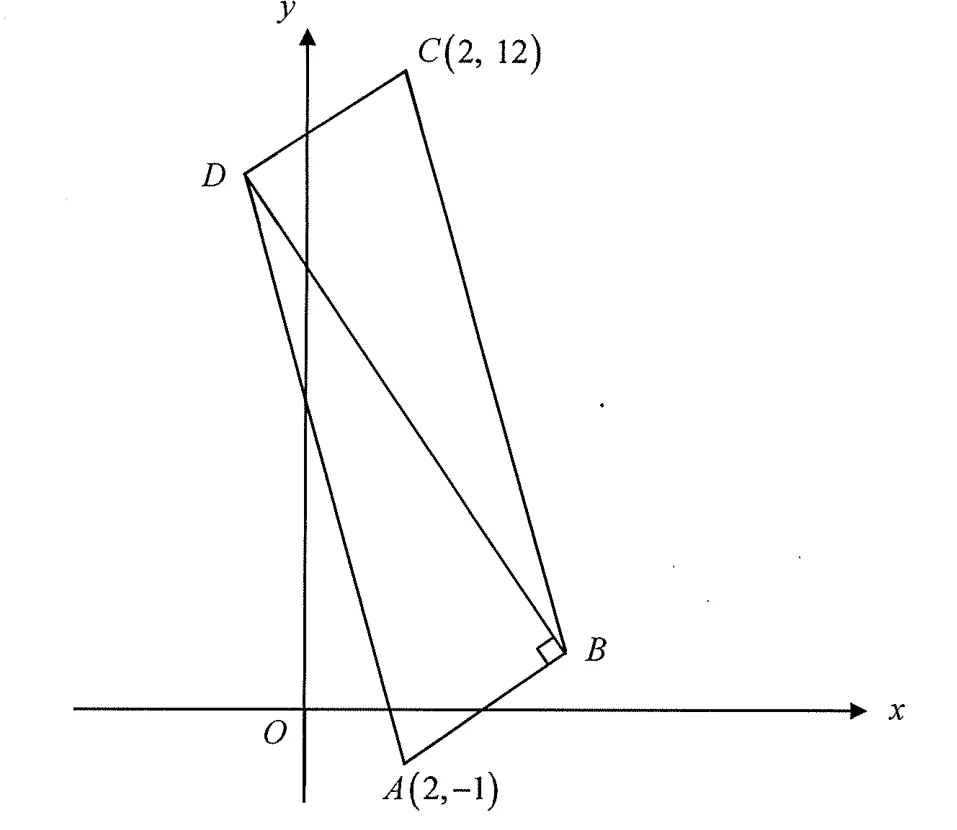
The parallelogram ABCD is such that the points A and C are (2, −1) and (2, 12) respectively. The line BD is parallel to the line 3x + 2y = 4 and is perpendicular to AB.

Parallelogram ABCD on the coordinate plane, with A(2,-1), C(2,12), D on the y-axis side and B in the lower right with a right angle marked at B
a Find the midpoint of AC. [1]
Show working
Midpoint of AC = ((2+2)/2, (−1+12)/2) = (2, 5.5)
b Show that the equation of BD is 2y = −3x + 17. [1]
Show working
Concept: Coordinate geometry
BD is parallel to 3x + 2y = 4 (i.e. y = −3/2 x + 2), so gradient of BD = −3/2
Diagonals of a parallelogram bisect each other, so BD passes through the midpoint of AC, (2, 5.5)
y − 5.5 = −3/2 (x − 2)
2y = −3x + 17 (shown)
c Find the coordinates of B. [3]
Show working
AB ⊥ BD, so gradient of AB = 2/3
Line AB through A(2, −1): y = 2/3 x − 7/3
Solving simultaneously with 2y = −3x + 17: x = 5, y = 1
B = (5, 1)
d Find the coordinates of D. [1]
Show working
Diagonals bisect each other, so D = 2 × midpoint(AC) − B = (2(2) − 5, 2(5.5) − 1)
D = (−1, 10)
5 Surds 6 marks
a Express 4/(√27 − 5) − √108/2 in the form a√3 + b, where a and b are integers. [3]
Show working
Concept: Surds
Rationalise: 4/(√27−5) × (√27+5)/(√27+5) = 4(√27+5)/(27−25) = 2(√27+5)
√27 = 3√3, so this becomes 2(3√3+5) = 6√3 + 10
√108 = √(36×3) = 6√3, so √108/2 = 3√3
Combine: 6√3 + 10 − 3√3 = 3√3 + 10
a = 3, b = 10 → 3√3 + 10
b By solving √(2x+3) + √(5x−3) = 0, explain why the equation has no solution. [3]
Show working
Concept: Surds — extraneous roots
√(2x+3) = −√(5x−3)
Squaring both sides: 2x+3 = 5x−3 → −3x = −6 → x = 2
Check x=2 in the original equation: LHS = √(2(2)+3) = √7; RHS = −√(5(2)−3) = −√7
LHS ≠ RHS, since a square root can never be negative
x = 2 does not satisfy the original equation, so the equation has no solution.
6 Quadratics & modelling 6 marks
a The equation of a curve is y = x² + 2x + p − 9, where p is a constant. Find the range of values of p for which the curve intersects the x-axis at two distinct points. [2]
Show working
Concept: Discriminant
Two distinct real roots → discriminant > 0: 2² − 4(1)(p−9) > 0
4 − 4p + 36 > 0 → 40 − 4p > 0
p < 10
b(i) The profit, $y, of a factory can be modelled by y = −(1/20)x² + 60x − 250, where x is the number of goods produced. Explain the significance of the value −250 in the given equation. [1]
Show working
When the factory produces zero goods (x=0), it makes a loss of $250 — this is the y-intercept of the curve.
b(ii) Express the equation in the form y = a(x−h)² + k. [2]
Show working
Concept: Completing the square
y = −(1/20)(x² − 1200x) − 250
Complete the square: x² − 1200x = (x−600)² − 600²
y = −(1/20)[(x−600)² − 360000] − 250 = −(1/20)(x−600)² + 18000 − 250
y = −(1/20)(x−600)² + 17750
b(iii) State the maximum profit and the corresponding number of goods that the factory must produce to maximise the profit. [1]
Show working
Maximum profit = $17,750, when 600 goods are produced.
7 Polynomials — remainder & factor theorem 7 marks

The remainder when 2x³ + 2x² − 13x + 12 is divided by x + a is three times the remainder when it is divided by x − a.

a Show that 2a³ + a² − 13a + 6 = 0. [2]
Show working
Concept: Remainder theorem
Let f(x) = 2x³ + 2x² − 13x + 12. Remainder ÷ (x+a) is f(−a); remainder ÷ (x−a) is f(a)
Given f(−a) = 3f(a): 2(−a)³+2(−a)²−13(−a)+12 = 3[2a³+2a²−13a+12]
−2a³+2a²+13a+12 = 6a³+6a²−39a+36
Bringing everything to one side: 8a³+4a²−52a+24 = 0
Dividing by 4: 2a³ + a² − 13a + 6 = 0 (shown)
b Solve this equation completely. [5]
Show working
Concept: Solving cubic equations
Let g(a) = 2a³+a²−13a+6. Try a=2: g(2) = 16+4−26+6 = 0, so (a−2) is a factor
Dividing: g(a) = (a−2)(2a²+5a−3)
Factorise the quadratic: 2a²+5a−3 = (2a−1)(a+3)
g(a) = (a−2)(2a−1)(a+3) = 0
a = 2, a = 1/2, a = −3
8 Exponential models 4 marks

The temperature T°C, of a chicken removed from a freezer and left on a table, is given by the formula T = 22 − 38e−kt, where t is the time in hours since the chicken was removed from the freezer.

a Find the temperature of the chicken at the moment it was removed from the freezer. [1]
Show working
At t=0: T = 22 − 38e⁰ = 22 − 38
T = −16°C
b When t = 2, the temperature of the chicken was 10.6°C. Find the value of k. [2]
Show working
10.6 = 22 − 38e−2k → 38e−2k = 11.4 → e−2k = 0.3
Taking ln of both sides: −2k = ln(0.3)
k = 0.602 (3 s.f.)
c Explain what will happen to the temperature of the chicken when it is left on the table for a long period of time. [1]
Show working
As t becomes large (t→∞), e−kt → 0, so T → 22 − 0
The temperature of the chicken will approach (but never reach) 22°C.
9 Partial fractions 6 marks
Express (2x³ + 6x² + 4) / [(x−1)(x²+3)] in partial fractions. [6]
Show working
Concept: Partial fractions
Degree of numerator (3) ≥ degree of denominator (3) → improper fraction, so divide first
(x−1)(x²+3) = x³−x²+3x−3. Dividing: quotient 2, remainder 8x²−6x+10
So the expression = 2 + (8x²−6x+10) / [(x−1)(x²+3)]
Let (8x²−6x+10)/[(x−1)(x²+3)] = A/(x−1) + (Bx+C)/(x²+3)
8x²−6x+10 = A(x²+3) + (Bx+C)(x−1)
Sub x=1: 12 = 4A → A = 3. Compare x²: 8 = A+B → B = 5. Sub x=0: 10 = 3A−C → C = −1
2 + 3/(x−1) + (5x−1)/(x²+3)
10 Trigonometric identities & graphs 8 marks
a It is given that tanB = −2/5, where 90° ≤ B ≤ 180°. Without solving for B, find the exact value of cos2B. [2]
Show working
Concept: Trig ratios & identities
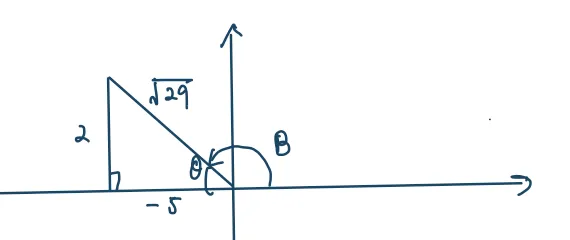
B is in the 2nd quadrant: opp = 2, adj = −5, hyp = √(2²+5²) = √29
cosB = −5/√29
cos2B = 2cos²B − 1 = 2(25/29) − 1
Right triangle in the second quadrant with opposite side 2, adjacent side -5, hypotenuse root 29, angle theta at the origin and angle B measured from the positive x-axis
cos2B = 21/29
b Use the identity for cos(A−B) to show that cos15° = (√2+√6)/4. [2]
Show working
Concept: Addition formula
cos15° = cos(60°−45°) = cos60°cos45° + sin60°sin45°
= (1/2)(√2/2) + (√3/2)(√2/2) = √2/4 + √6/4
= (√2+√6)/4 (shown)
c(i) The function f is defined, for 0 ≤ x ≤ π, by f(x) = 1 + 3sin2x. Find the amplitude and period of f. [2]
Show working
Concept: Trigonometric graphs
Amplitude = 3, Period = π
c(ii) Sketch the graph y = f(x) for 0 ≤ x ≤ π. [2]
Show working
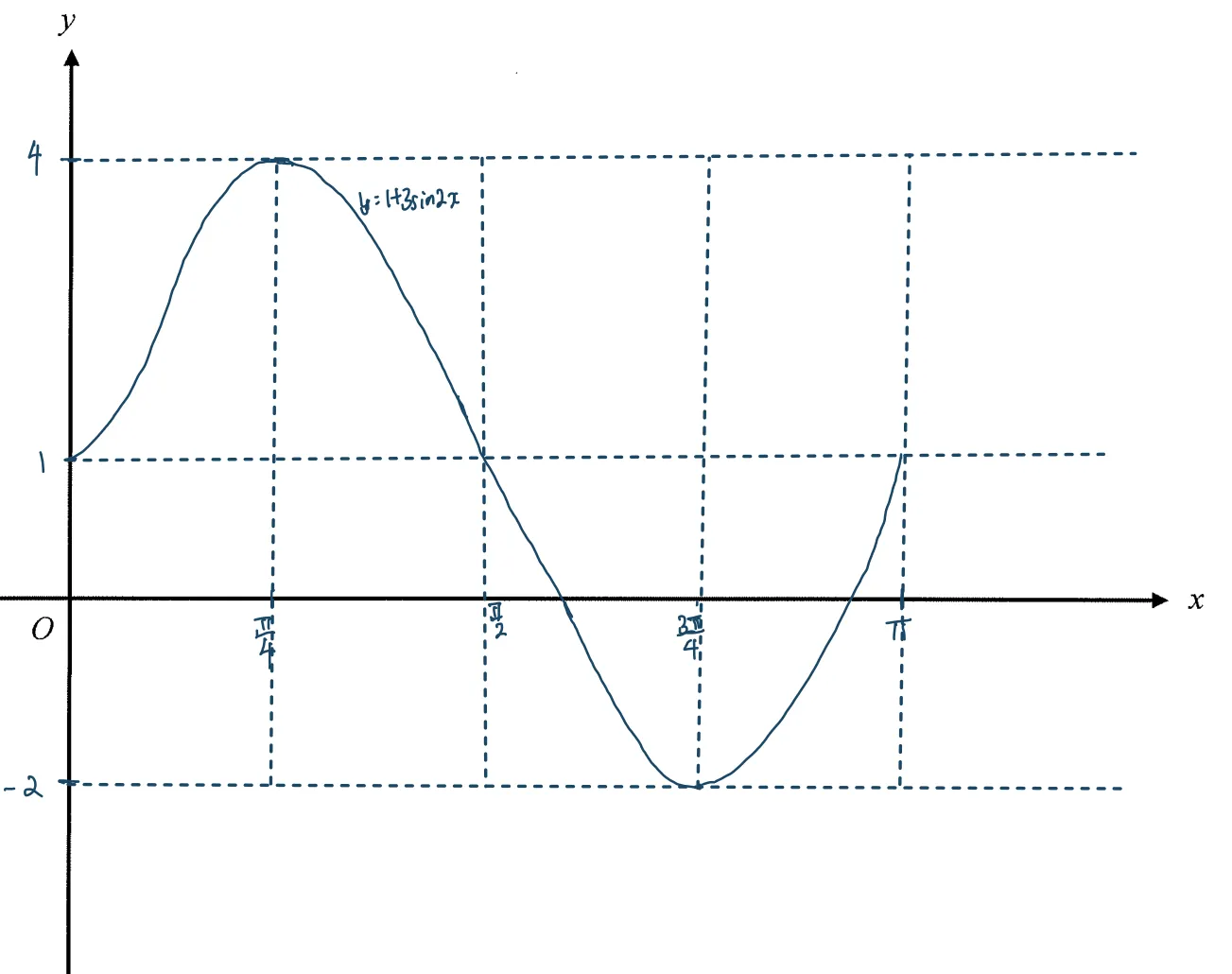
Max = 3+1 = 4 at x = π/4; min = −3+1 = −2 at x = 3π/4; passes through (0,1), (π/2,1), (π,1)
Sine curve y equals 1 plus 3 sine 2x, rising from (0,1) to a maximum of 4 at x = pi over 4, falling through (pi/2, 1) to a minimum of -2 at x = 3 pi over 4, and rising back to (pi, 1)
11 Circles & coordinate geometry 7 marks

The equation of a circle, C, is x² + y² − 10x + 8y − 59 = 0.

a Find the coordinates of the centre and the radius of circle C. [3]
Show working
Concept: Circles — completing the square
x²−10x + y²+8y − 59 = 0
(x−5)²−25 + (y+4)²−16 − 59 = 0 → (x−5)²+(y+4)² = 100
Centre (5, −4), radius = 10
b Show that x = −5 is a tangent to the circle. [2]
Show working
Sub x=−5 into the circle equation: 25+y²+50+8y−59=0 → y²+8y+16=0
Discriminant = 8² − 4(1)(16) = 64−64 = 0
Since the discriminant = 0, the line meets the circle at exactly one point, so x = −5 is a tangent (shown).
c Explain whether the point (12, 1) lies outside, inside or on the circle. [2]
Show working
(x−5)²+(y+4)² = 100 is the circle equation (r²=100)
Sub (12,1): (12−5)²+(1+4)² = 49+25 = 74
Since 74 < r², the point (12, 1) lies inside the circle.
12 Logarithms 8 marks

Solve the following equations.

a 3 + log₂(x+4) = 2log₂(3x−4) [4]
Show working
Concept: Logarithms
Domain: x+4>0 → x>−4; 3x−4>0 → x>4/3
3 + log₂(x+4) = log₂(3x−4)²
log₂(x+4) − log₂(3x−4)² = −3 → (x+4)/(3x−4)² = 2⁻³ = 1/8
8(x+4) = 9x²−24x+16 → 9x²−32x−16 = 0
Factorise: (x−4)(9x+4) = 0 → x=4 or x=−4/9 (rejected, x>4/3)
x = 4
b 2log₃y − logy3 = 1 [4]
Show working
Concept: Logarithms — change of base
logy3 = 1/log₃y (change of base)
Let p = log₃y: 2p − 1/p = 1 → 2p²−p−1 = 0
Factorise: (2p+1)(p−1) = 0 → p = −1/2 or p = 1
log₃y = −1/2 → y = 3⁻½; log₃y = 1 → y = 3
y = 1/√3 or y = 3
13 R-formula & trig proofs 6 marks
a Express √3 sinθ − 2cosθ in the form R sin(θ−α), where R > 0 and 0 < α < π/2. [3]
Show working
Concept: R-formula
√3 sinθ − 2cosθ ≡ R sinθcosα − R cosθsinα
Compare: Rcosα = √3, Rsinα = 2
tanα = 2/√3 → α = tan⁻¹(2/√3) = 0.857 rad
R² = (√3)²+2² = 7 → R = √7
√7 sin(θ−0.857)
b Prove that cotθ − tanθ = 2cot2θ. [3]
Show working
Concept: Trig proofs
LHS = cosθ/sinθ − sinθ/cosθ = (cos²θ−sin²θ)/(sinθcosθ)
= cos2θ / (½sin2θ)  [since cos²θ−sin²θ=cos2θ, sinθcosθ=½sin2θ]
= 2cos2θ/sin2θ = 2cot2θ = RHS (shown)
14 Binomial theorem 7 marks
a The coefficient of x² in the expansion of (2−3x)(1+ax)⁶ is 12, where a is an integer. Find the value of the constant a. [4]
Show working
Concept: Binomial theorem
(1+ax)⁶ = 1 + 6ax + 15a²x² + …
(2−3x)(1+6ax+15a²x²+…): coefficient of x² is 2(15a²) − 3(6a) = 30a²−18a
Set equal to 12: 30a²−18a−12 = 0 → divide by 6: 5a²−3a−2 = 0
Factorise: (5a+2)(a−1) = 0 → a = −2/5 (rejected, a is an integer) or a = 1
a = 1
b In the expansion of (x² + 2/x)¹⁰, find the coefficient of 1/x. [3]
Show working
Concept: Binomial theorem — general term
General term: Tr+1 = C(10,r)(x²)10−r(2/x)r = C(10,r)·2r·x20−3r
Want x⁻¹: 20−3r = −1 → r = 7
Coefficient = C(10,7) × 2⁷ = 120 × 128
15360

Meet Your Tutor

The Tutor Behind These Solutions

Other Upper Sec Math Tutors

Teacher Qian Wei
Qian Wei
A Math · E Math
Teacher Clarence Lee
Clarence Lee
A Math · E Math
Teacher Hao Wei
Hao Wei
A Math · E Math
Teacher Hassan
Hassan
A Math · E Math
Teacher Marius
Marius
E Math
Teacher Jason Yek
Jason Yek
A Math · E Math
Teacher Abigail
Abigail
A Math
Teacher Pamela
Pamela
E Math

All Sec 3 & Sec 4 Math Class Slots

Subject
Location
Day
Start End
Tutor
S3 A-MathTampinesMon5:00 PM7:00 PM
S3 A-MathBukit TimahTue5:00 PM7:00 PM
S3 A-MathKovanThu4:30 PM6:30 PM
S3 A-MathKovanSat10:00 AM12:00 PM
S3 E-MathTampinesTue6:30 PM8:30 PM
S3 E-MathBukit TimahTue7:30 PM9:30 PM
S3 E-MathKovanTue7:30 PM9:30 PM
S3 E-MathMarine ParadeThu7:00 PM9:00 PM
S3 E-MathKovanSat2:00 PM4:00 PM
S3 E-MathTampinesFri5:00 PM7:00 PM
S4 E-MathKovanMon5:00 PM7:00 PM
S4 A-MathNovenaMon6:30 PM8:30 PM
S4 A-MathKovanMon7:00 PM9:00 PM
S4 A-MathBukit TimahTue5:00 PM7:00 PM
S4 E-MathKovanTue5:00 PM7:00 PM
S4 A-MathMarine ParadeTue6:30 PM8:30 PM
S4 E-MathBukit TimahTue7:30 PM9:30 PM
S4 A-MathTampinesWed4:30 PM6:30 PM
S4 A-MathKovanThu7:30 PM9:30 PM
S4 E-MathKovanFri5:00 PM7:00 PM
S4 E-MathTampinesFri5:00 PM7:00 PM
S4 A-MathTampinesFri7:00 PM9:00 PM
S4 A-MathKovanSat12:00 PM2:00 PM
S4 E-MathKovanSat4:00 PM6:00 PM
S4 E-MathBishanSun9:00 AM11:00 AM
S4 A-MathBishanSun11:00 AM1:00 PM
S4 A-MathKovanSun12:00 PM2:00 PM
S4 E-MathTampinesSun1:00 PM3:00 PM
S4 E-MathJurong EastSun3:00 PM5:00 PM
S4 A-MathJurong EastSun5:00 PM7:00 PM
Secondary Sch Tuition → JC Tuition →
Testimonial

FAQ

Common questions about this paper

What topics are tested in this 2025 CCHS Sec 3 Additional Math EOY paper?

This paper covers the discriminant and nature of roots, trigonometric equations and identities, coordinate geometry (midpoints, gradients, perpendicular lines), surds, quadratic curve modelling, the remainder and factor theorem for solving cubic equations, exponential growth and decay models, partial fractions, the R-formula, circle equations, logarithms, and the binomial theorem — effectively a full sweep of the Sec 3 Additional Mathematics (4049) syllabus.

How do you find the range of values of k for which a quadratic has no real roots?

Rearrange the equation into ax² + bx + c = 0 form, then require the discriminant b² − 4ac to be less than zero. Solving the resulting inequality gives the range of the unknown constant for which the equation has no real roots.

How do you solve a trigonometric equation involving sec² and tan²?

Use the identity sec²θ = tan²θ + 1 to rewrite the whole equation in terms of tanθ alone, then solve the resulting quadratic in tanθ. Each valid value of tanθ is then solved for θ using the CAST rule to find every angle in the given range, not just the principal value.

How do you find the centre and radius of a circle from its general equation?

Complete the square separately on the x-terms and the y-terms of x² + y² + 2gx + 2fy + c = 0. This rewrites the equation as (x−a)² + (y−b)² = r², where (a,b) is the centre and r is the radius.

Is this Additional Mathematics or O-Level E-Math?

This paper is Additional Mathematics (Syllabus 4049), sat by students taking the A-Math elective — not the standard O-Level E-Math (Syllabus 4052). Topics like the R-formula, partial fractions, and the remainder theorem are unique to the A-Math syllabus.