Teacher Marius
Solutions & breakdown by Teacher Marius

2024 Anglican High S2 Math — Full Worked Solutions

Anglican High School · Secondary 2 · 3 October 2024

Full worked solutions to Anglican High School's 2024 Secondary 2 End-of-Year Examination for Mathematics (Syllabus 4052). All 18 questions are reproduced below with their original mark allocations, covering a broad sweep of the Sec 2 Mathematics syllabus.

18 questions · 80 marks · 2 hours

How to use this page: each part has a "Show working" toggle underneath it — try the question yourself first, then click to reveal the full step-by-step solution and final answer.
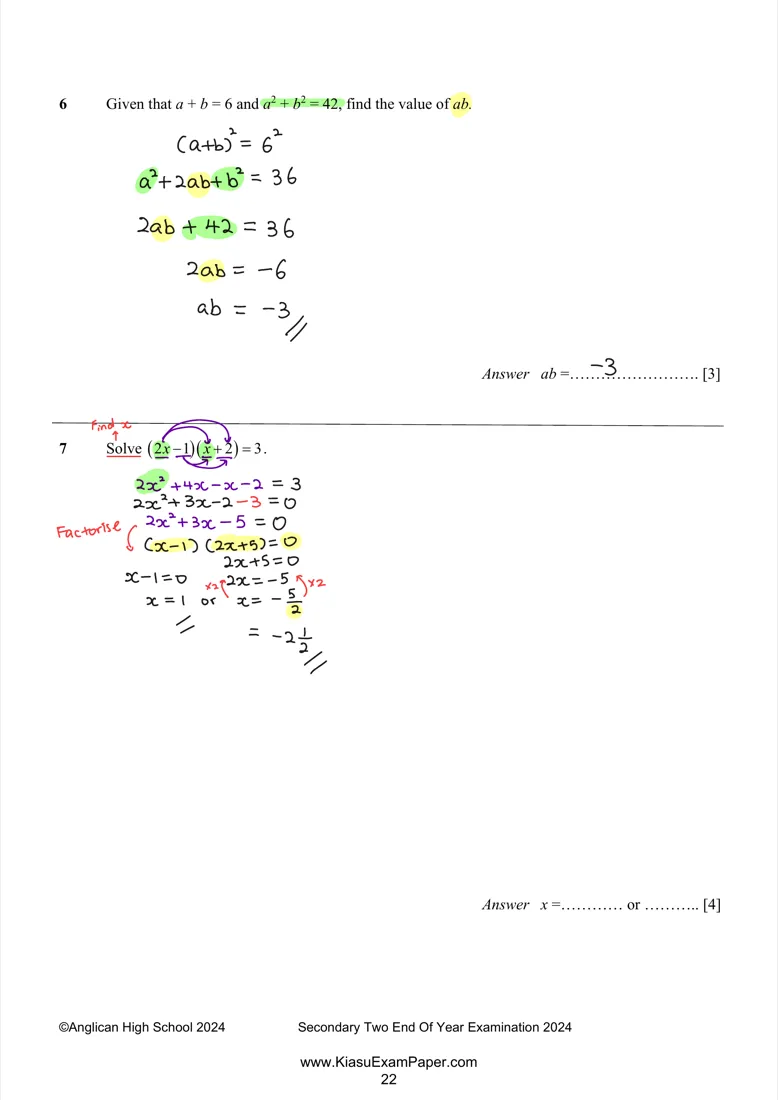
Preview of the annotated PDF answer scheme, with Teacher Marius's handwritten concept notes and worked steps Click to expand

Want the full blank question paper and answer key with annotations to help you ace your exams?

Annotations by Teacher Marius

1 Linear inequalities 3 marks
a Solve the inequality 3x − 11 < 5x + 16. [2]
Show working
Concept: Linear inequalities
3x − 5x < 16 + 11 → −2x < 27
Dividing by −2 (a negative number) — flip the inequality sign
x > −13.5
b Hence, write down the smallest possible value of x, if x is an integer. [1]
Show working
x must be greater than −13.5, so the smallest integer satisfying this is −13.
x = −13
2 Expansion & simplification 3 marks
Simplify (2x−1)(x+5) − (5x+1)(x−4). [3]
Show working
Concept: Expanding brackets
Expand (2x−1)(x+5) = 2x²+10x−x−5 = 2x²+9x−5
Expand (5x+1)(x−4) = 5x²−20x+x−4 = 5x²−19x−4
Subtract: (2x²+9x−5) − (5x²−19x−4) = 2x²+9x−5−5x²+19x+4
−3x² + 28x − 1
3 Algebraic fractions 6 marks

Simplify the following as a single fraction in its simplest form.

a (x²−5x−6)/(3x+3) × (x−2)/(x²−5x+6) [3]
Show working
Concept: Factorising before cancelling
Factorise: x²−5x−6 = (x−6)(x+1); 3x+3 = 3(x+1); x²−5x+6 = (x−2)(x−3)
= [(x−6)(x+1)] / [3(x+1)] × (x−2) / [(x−2)(x−3)]
Cancel the common factors (x+1) and (x−2)
(x−6) / [3(x−3)]
b 4/(t−3) − (t−9)/(t²−9) [3]
Show working
Concept: Common denominators
t²−9 = (t+3)(t−3), so the common denominator is (t+3)(t−3)
= 4(t+3)/[(t+3)(t−3)] − (t−9)/[(t+3)(t−3)]
= [4(t+3) − (t−9)] / [(t+3)(t−3)] = (4t+12−t+9) / [(t+3)(t−3)] = (3t+21)/[(t+3)(t−3)]
3(t+7) / [(t+3)(t−3)]
4 Changing the subject 4 marks
Make c the subject of the equation b/a = √[(c²+1)/c²]. [4]
Show working
Concept: Changing the subject
Square both sides: b²/a² = (c²+1)/c²
Cross-multiply: b²c² = a²(c²+1) = a²c²+a²
Bring all c terms to one side: b²c² − a²c² = a²
Factorise: c²(b²−a²) = a² → c² = a²/(b²−a²)
c = ±√[a² / (b²−a²)]
5 Factorisation 3 marks

Factorise

a 4p² + 2pq [1]
Show working
Factorise out the highest common factor, 2p
2p(2p+q)
b 10gh − 2gf + 5h − f [2]
Show working
Concept: Factorising by grouping
4 terms → group into pairs: (10gh + 5h) − (2gf + f)
= 5h(2g+1) − f(2g+1)
(2g+1)(5h−f)
6 Algebraic identities 3 marks
Given that a + b = 6 and a² + b² = 42, find the value of ab. [3]
Show working
Concept: (a+b)² identity
(a+b)² = 6² → a²+2ab+b² = 36
Substitute a²+b²=42: 42+2ab = 36 → 2ab = −6
ab = −3
7 Quadratic equations 4 marks
Solve (2x−1)(x+2) = 3. [4]
Show working
Concept: Quadratic equations
Expand: 2x²+4x−x−2 = 3 → 2x²+3x−2−3 = 0 → 2x²+3x−5 = 0
Factorise: (x−1)(2x+5) = 0
x = 1 or x = −2½
8 Probability & simultaneous equations 6 marks

Some chips are placed inside a bag. The chips consist of x red chips, y blue chips and 30 green chips. A chip is randomly selected from the bag.

a Express the probability of selecting a red chip in terms of x and y. [1]
Show working
P(red) = x / (x+y+30)
b Express the probability of selecting a blue chip in terms of x and y. [1]
Show working
P(blue) = y / (x+y+30)
c The probability of selecting a red chip is 4/15 and the probability of selecting a blue chip is 1/3. Form two equations in x and y and solve for the value of x and y. [4]
Show working
Concept: Simultaneous equations
x/(x+y+30) = 4/15 → 15x = 4(x+y+30) → 11x = 4y+120 …(1)
y/(x+y+30) = 1/3 → 3y = x+y+30 → x = 2y−30 …(2)
Substitute (2) into (1): 11(2y−30) = 4y+120 → 22y−330 = 4y+120 → 18y = 450 → y = 25
Substitute y=25 into (2): x = 2(25)−30 = 20
x = 20 and y = 25
9 Map scales 5 marks

An actual region of a plot of land 144 km² is represented by an area of 9 cm² on the map.

a If the area of a lake on the map is 0.6 cm², find its actual area in square kilometres. [2]
Show working
Concept: Area scale
Area scale: 9 cm² : 144 km² → (÷9) → 1 cm² : 16 km²
(×0.6) → 0.6 cm² : 9.6 km²
9.6 km²
b Find the scale of the map in the form 1 : n. [3]
Show working
Concept: Linear scale from area scale
Area scale 1 cm² : 16 km² → linear (distance) scale is the square root: 1 cm : 4 km
Convert 4 km to cm: 4 km = 4000 m = 400,000 cm
1 : 400,000
10 Pythagoras' theorem 6 marks

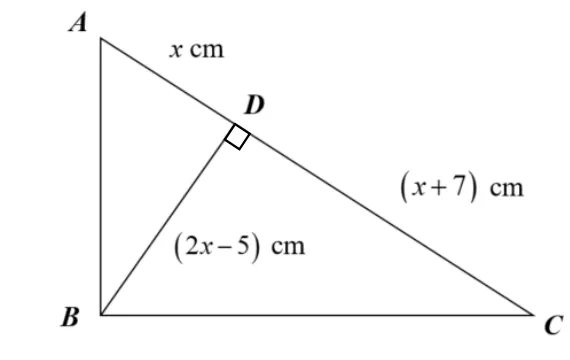
In the diagram, ABC is a triangle where ADC is a straight line and ∠BDC = 90°. AD = x cm, DC = (x+7) cm and BD = (2x−5) cm.

Triangle ABC with D on straight line ADC, AD labelled x cm, DC labelled x+7 cm, BD labelled 2x-5 cm, and a right angle marked at D between BD and DC
a Given that BC² = 30x + 19, show that x = 5. [3]
Show working
Concept: Pythagoras' theorem
In right triangle BDC (right angle at D): BC² = BD² + DC² = (2x−5)² + (x+7)²
30x+19 = 4x²−20x+25 + x²+14x+49 = 5x²−6x+74
0 = 5x²−36x+55
Factorise: (x−5)(5x−11) = 0 → x = 5 or x = 11/5
x = 11/5 is rejected since it makes BD = 2(11/5)−5 negative, which is not a valid length
x = 5 (shown)
b Hence, determine if ABC is a right-angled triangle. [3]
Show working
Concept: Converse of Pythagoras' theorem
With x=5: AD=5, DC=12, BD=5
In right triangle ABD: AB² = AD²+BD² = 25+25 = 50
BC² = 30(5)+19 = 169; AC = AD+DC = 5+12 = 17, so AC² = 289
Check: AB²+BC² = 50+169 = 219, but AC² = 289
Since AB²+BC² ≠ AC², by the converse of Pythagoras' theorem, triangle ABC is not a right-angled triangle.
11 Similar triangles 5 marks

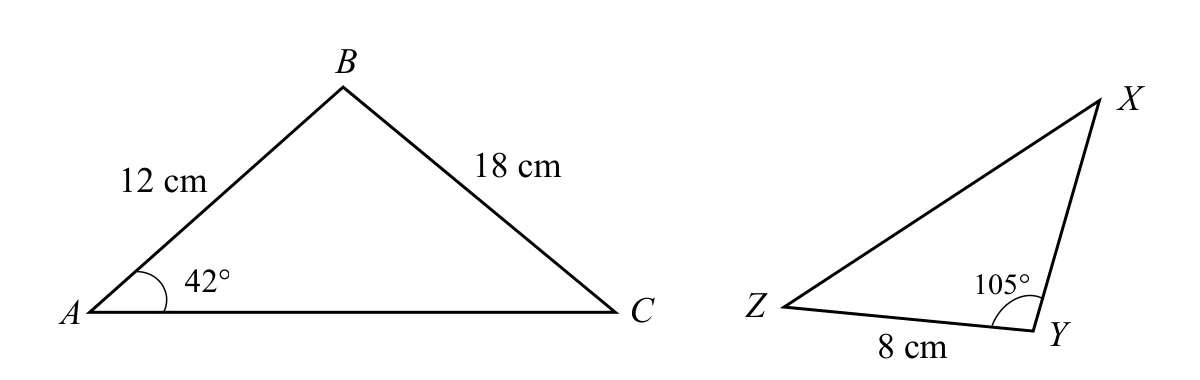
In the diagram below not drawn to scale, triangle ABC and triangle ZYX are similar. It is given that angle BAC = 42°, angle ZYX = 105°, AB = 12 cm, BC = 18 cm and YZ = 8 cm.

Two triangles: triangle ABC with angle A = 42 degrees, AB = 12cm, BC = 18cm; and triangle ZYX with angle Y = 105 degrees, ZY = 8cm, similar to triangle ABC
a Find ∠ABC. [1]
Show working
Since the triangles are similar with correspondence A↔Z, B↔Y, C↔X: ∠ABC = ∠ZYX
∠ABC = 105°
b Find ∠YXZ. [2]
Show working
∠YXZ = ∠BCA = 180° − 42° − 105° (angle sum of triangle)
∠YXZ = 33°
c Calculate the length of XY. [2]
Show working
Concept: Similar triangles — ratio of sides
XY corresponds to BC, and YZ corresponds to AB: XY/BC = YZ/AB → XY/18 = 8/12
XY = 12 cm
12 Trigonometry — right & isosceles triangles 3 marks

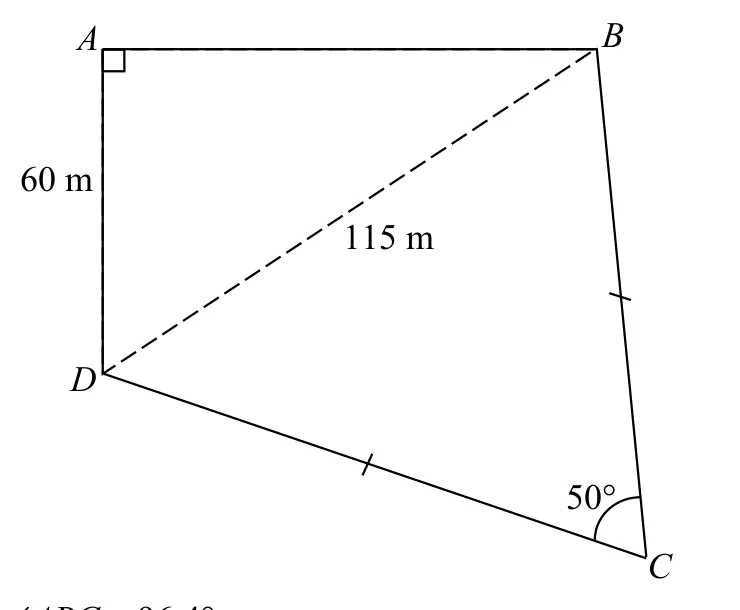
The diagram shows a field ABCD on horizontal ground, crossed by a path BD. AD = 60 m, BD = 115 m and BC = CD. Angle BAD = 90° and angle BCD = 50°.

Quadrilateral field ABCD with a right angle at A, AD = 60m, diagonal path BD = 115m, BC equal to CD (marked with tick marks), and angle BCD = 50 degrees
Show that ∠ABC = 96.4°. [3]
Show working
Concept: Isosceles triangle base angles + right-angled trigonometry
Triangle BCD is isosceles (BC=CD), so ∠DBC = ∠BDC = (180°−50°)/2 = 65°
In right triangle ABD (right angle at A): sin(∠ABD) = AD/BD = 60/115
∠ABD = sin⁻¹(60/115) = 31.449°
∠ABC = ∠ABD + ∠DBC = 31.449° + 65°
∠ABC = 96.4° (1 d.p.) (shown)
13 Statistics — mean, median, mode 4 marks
5 positive integers have a mean of 6, a median of 6 and a mode of 9. Find the 5 numbers. [4]
Show working
Concept: Mean, median and mode
Total of all 5 numbers = mean × 5 = 30
Arranged in order, the median (3rd value) is 6, so the numbers look like: _, _, 6, _, _
The mode is 9, so 9 must appear at least twice — and since values after the median must be ≥ 6, both the 4th and 5th positions are 9
Sum of the first two values = 30 − 6 − 9 − 9 = 6, using two different positive integers (not repeating, or 9 would tie/lose as the mode)
1, 5, 6, 9, 9 (or equivalently 2, 4, 6, 9, 9)
14 Trigonometry — right-angled triangles 4 marks

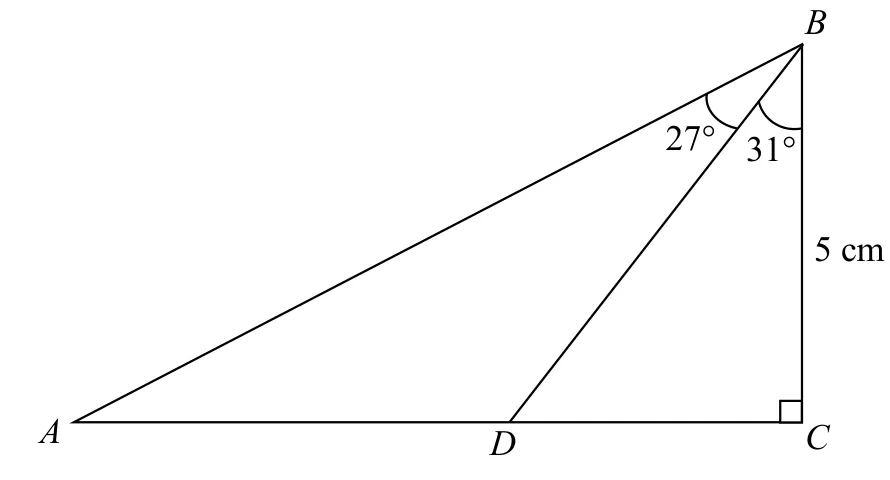
In the diagram, not drawn to scale, BC = 5 cm, angle ACB = 90°, angle ABD = 27° and angle DBC = 31°.

Triangle ABC with a right angle at C, point D on AC, angle ABD = 27 degrees, angle DBC = 31 degrees, and BC = 5cm
i Find the length of DC. [2]
Show working
Concept: Right-angled trigonometry (tangent)
In right triangle BDC (right angle at C): tan31° = DC/5 → DC = 5tan31°
DC = 3.00 cm (3 s.f.)
ii Find the length of AD. [2]
Show working
Concept: Right-angled trigonometry
∠ABC = ∠ABD + ∠DBC = 27°+31° = 58°
In right triangle ABC (right angle at C): tan58° = AC/5 → AC = 5tan58°
AD = AC − DC = 5tan58° − 5tan31°
AD = 5.00 cm (3 s.f.)
15 Rate & proportion 5 marks

15 technicians can complete the installation of a new computer network in 12 days.

i If the project needs to be finished in 9 days instead, calculate the additional number of technicians required to complete the job. [2]
Show working
Concept: Inverse proportion
Technicians × days = constant amount of work: 15 × 12 = 180
For 9 days: number of technicians = 180 ÷ 9 = 20
Additional technicians needed = 20 − 15
5 additional technicians
ii State an assumption you have made in part (i). [1]
Show working
The rate of work is the same (constant) for every technician.
iii Each of the 15 technicians worked 12 hours a day for 9 days. Each of them are paid $40 per hour for the first 8 hours each day and $60 for every subsequent hour. What is the total payment for each technician? [2]
Show working
Payment per day = (8×$40) + (4×$60) = $320 + $240 = $560
Total over 9 days = $560 × 9
$5040
16 Statistics — histograms 3 marks

The time taken (in minutes) for Keren-Happuch to complete each of the 25 art pieces is shown in a stem-and-leaf diagram (stems 1–4, representing 10s of minutes).

a Using the class interval starting from 10 < t ≤ 20, where t is the time taken to complete an art piece in minutes, complete the frequency table for the data. [1]
Show working
Reading off the stem-and-leaf diagram and tallying each class interval:
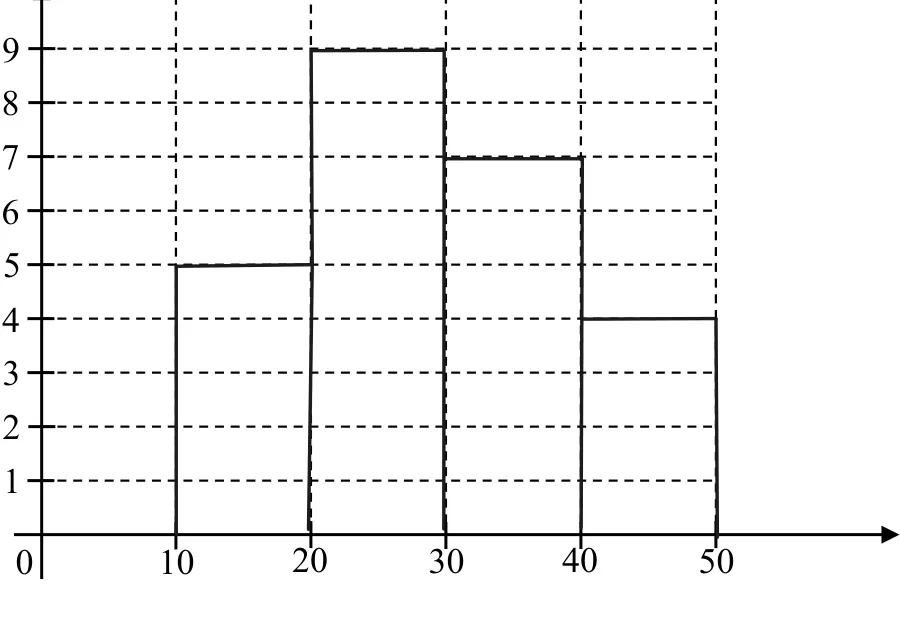
10<t≤20: 5  ·  20<t≤30: 9  ·  30<t≤40: 7  ·  40<t≤50: 4
b With the given axes provided, construct a histogram to illustrate the data. [2]
Show working
Histogram with bars of height 5, 9, 7, 4 over the intervals 10-20, 20-30, 30-40, 40-50 minutes respectively
17 Mensuration — cones & spheres 8 marks

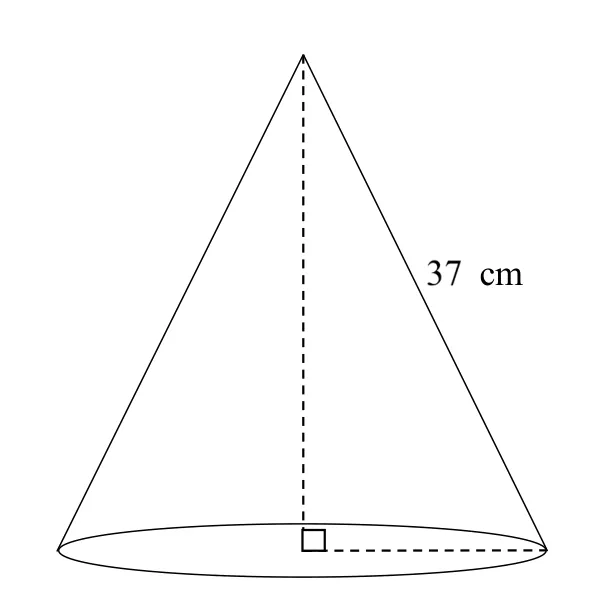
The diagram below shows a block of wax in the shape of a cone with a slant height of 37 cm.

Cone with slant height 37cm, a dashed vertical line for the height, and a right angle marked between the height and the base radius
i Given that the curved surface area of the cone is 444π cm². Show that the radius of the cone is 12 cm. [1]
Show working
Concept: Curved surface area of a cone
Curved SA = πrl → πr(37) = 444π → r = 444/37
r = 12 cm (shown)
ii The cone in (i) has a vertical height of 35 cm. It is melted and made into hemispherical candles, each of radius 1.5 cm. Assuming there is no loss of wax, find the number of candles that could be made. [3]
Show working
Concept: Volume of a cone & a hemisphere
Volume of cone = (1/3)πr²h = (1/3)π(12²)(35) = 1680π
Volume of 1 hemisphere = (2/3)πr³ = (2/3)π(1.5³) = 2.25π
Number of candles = 1680π ÷ 2.25π = 746.67… → round down, since a partial candle isn't a whole candle
746 candles
iii Each candle in (ii) is coated with a layer of golden spray. Given that the spray costs $5 per square metre, how much does it cost to spray all the candles? [4]
Show working
Concept: Surface area of a hemisphere & unit conversion
Total surface area of 1 hemisphere = curved part + flat circular base = 2πr² + πr² = 3πr² = 3π(1.5²) = 21.206 cm² (5 s.f.)
TSA of 746 candles = 21.206 × 746 = 15819.49 cm²
Convert to m² (1 m² = 10,000 cm²): 15819.49 ÷ 10000 = 1.581949 m²
Cost = 1.581949 × $5
$7.91 (2 d.p.)
18 Graphs of functions 5 marks

A company selling balloons makes a profit of y thousand dollars from x thousand balloons ordered. The relationship may be expressed as y = 5x − x² − 3.

a Calculate the value of p, given that (0.5, p) lies on the curve. [1]
Show working
Substitute x=0.5: y = 5(0.5) − (0.5)² − 3 = 2.5 − 0.25 − 3
p = −0.75
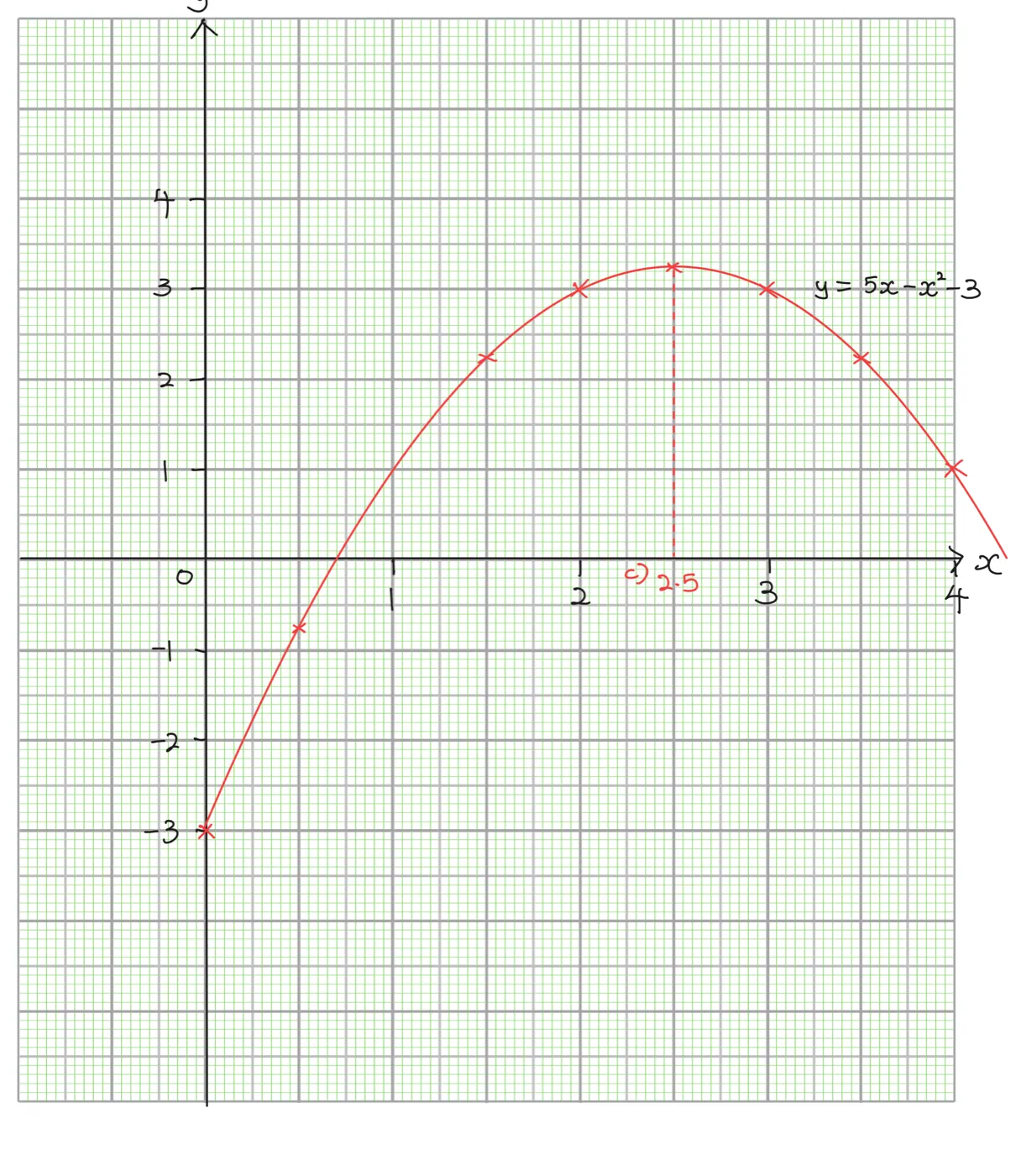
b On a piece of graph paper, using a scale of 4 cm to represent 1 unit, draw a horizontal x-axis for 0 ≤ x ≤ 4. Using a scale of 2 cm to represent 1 unit, draw a vertical y-axis for −3 ≤ y ≤ 4. On your axes, plot the points given in the table and join them with a smooth curve. [3]
Show working
Smooth parabola through the points (0,-3), (0.5,-0.75), (1.5,2.25), (2,3), (2.5,3.25), (3,3), (3.5,2.25), (4,1), peaking at x=2.5
c Use your graph to find the number of balloons the company should order in order to obtain the maximum profit. [1]
Show working
The curve peaks at x = 2.5 (thousand balloons)
2500 balloons

Meet Your Tutor

The Tutor Behind These Solutions

Other Lower Sec Math Tutors

Teacher Qian Wei
Qian Wei
Lower Sec Math
Teacher Clarence Lee
Clarence Lee
Lower Sec Math
Teacher Hao Wei
Hao Wei
Lower Sec Math
Teacher Hassan
Hassan
Lower Sec Math
Teacher Zoey
Zoey
Lower Sec Math
Teacher Jason Yek
Jason Yek
Lower Sec Math

All Sec 1 & Sec 2 Math Class Slots

Subject
Location
Day
Start End
Tutor
S1 MathBukit TimahTue3:00 PM5:00 PM
S1 MathMarine ParadeThu5:00 PM7:00 PM
S1 MathTampinesFri3:00 PM5:00 PM
S1 MathJurong EastFri5:00 PM7:00 PM
S1 MathKovanSat11:00 AM1:00 PM
S1 MathTampinesSun9:00 AM11:00 AM
S1 MathKovanSun2:00 PM4:00 PM
S1 MathTampinesThu5:00 PM7:00 PM
S2 MathTampinesMon3:00 PM5:00 PM
S2 MathNovenaMon4:30 PM6:30 PM
S2 MathKovanTue5:00 PM7:00 PM
S2 MathJurong EastFri7:30 PM9:30 PM
S2 MathBukit TimahSat12:00 PM2:00 PM
S2 MathNovenaSat2:00 PM4:00 PM
S2 MathKovanSat3:00 PM5:00 PM
S2 MathKovanSun10:00 AM12:00 PM
S2 MathTampinesSun11:00 AM1:00 PM
S2 MathTampinesThu7:30 PM9:30 PM
S2 MathTampinesFri7:30 PM9:30 PM
S2 MathKovanSun2:30 PM4:30 PM
Secondary Sch Tuition →
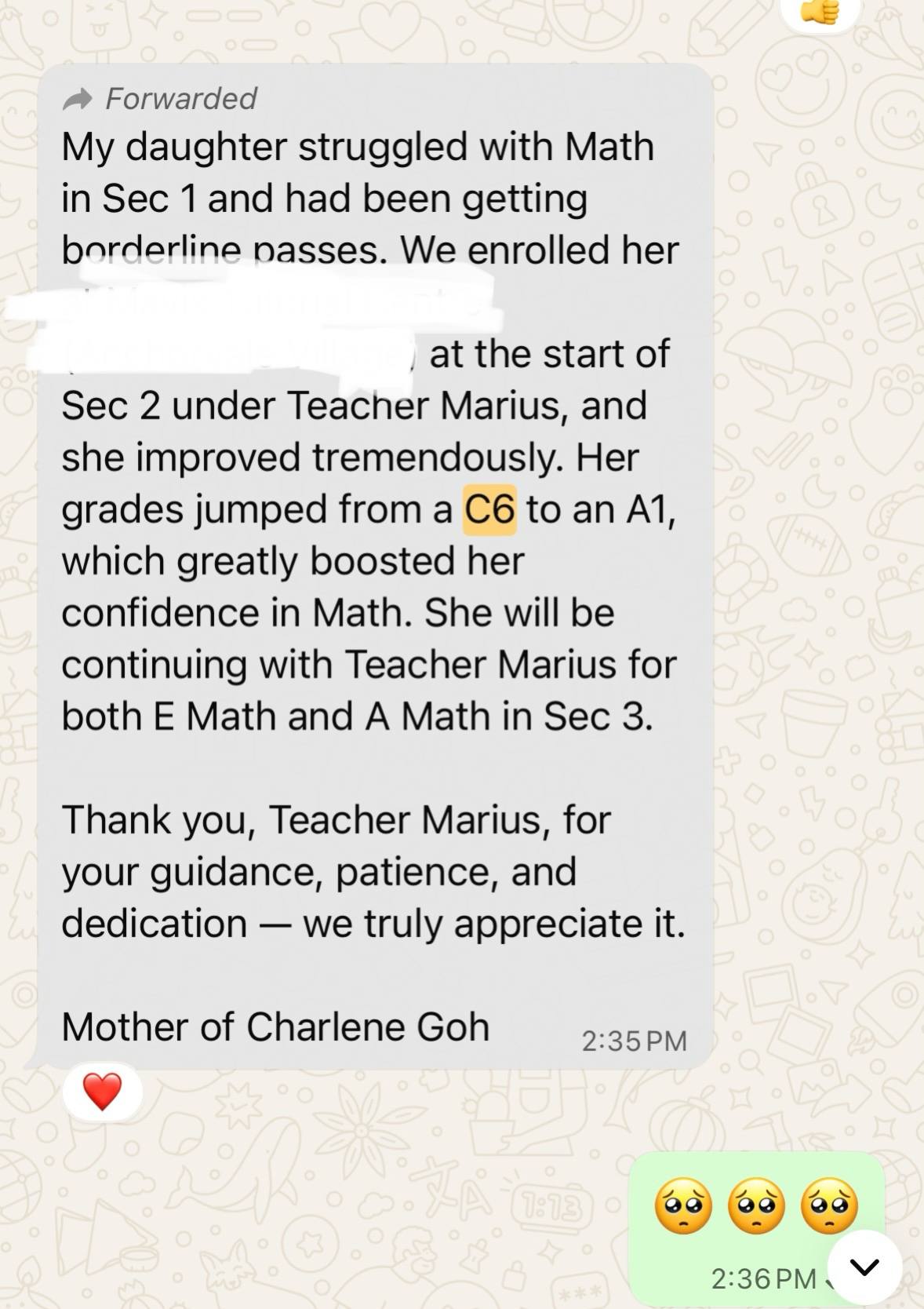
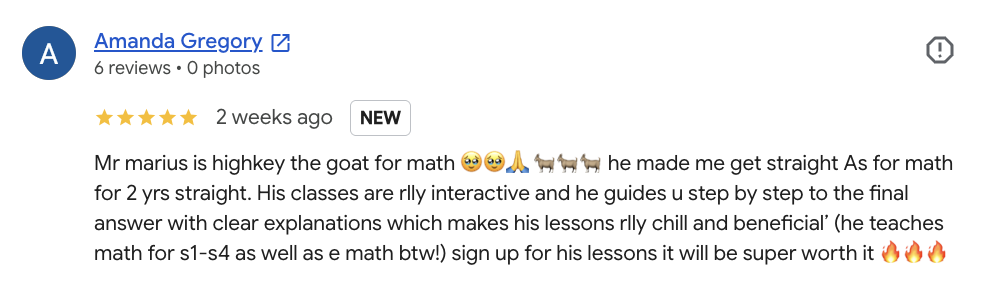
Testimonial

FAQ

Common questions about this paper

What topics are tested in this 2024 Anglican High Sec 2 Math EOY paper?

This paper covers linear inequalities, expansion and simplification, algebraic fractions, changing the subject of a formula, factorisation, quadratic equations, probability, map scales, Pythagoras' theorem, similar triangles, trigonometry (right-angled and isosceles triangles), statistics (mean, median, mode, histograms), mensuration of cones and spheres, rate and inverse proportion, and graphs of quadratic functions — a broad sweep of the Sec 2 Mathematics syllabus.

How do you know when to flip an inequality sign?

Flip the inequality sign whenever you multiply or divide both sides by a negative number. Adding, subtracting, or multiplying/dividing by a positive number never changes the direction of the inequality.

How do you use the converse of Pythagoras' theorem to check if a triangle is right-angled?

Find the squares of all three sides. If the sum of the squares of the two shorter sides equals the square of the longest side, the triangle is right-angled (with the right angle opposite the longest side). If they are not equal, the triangle is not right-angled.

How do you find the actual distance scale from an area scale on a map?

The area scale is the square of the linear (distance) scale. So take the square root of the area scale factor to get the distance scale — for example, an area scale of 1 cm² : 16 km² gives a distance scale of 1 cm : 4 km, since √16 = 4.

Is this O-Level E-Math or Additional Math?

This is a Secondary 2 paper that follows the standard O-Level Mathematics (E-Math, Syllabus 4052) track, not Additional Mathematics. It builds the foundational algebra, geometry, trigonometry and statistics skills that carry into the Sec 3/4 O-Level E-Math syllabus.